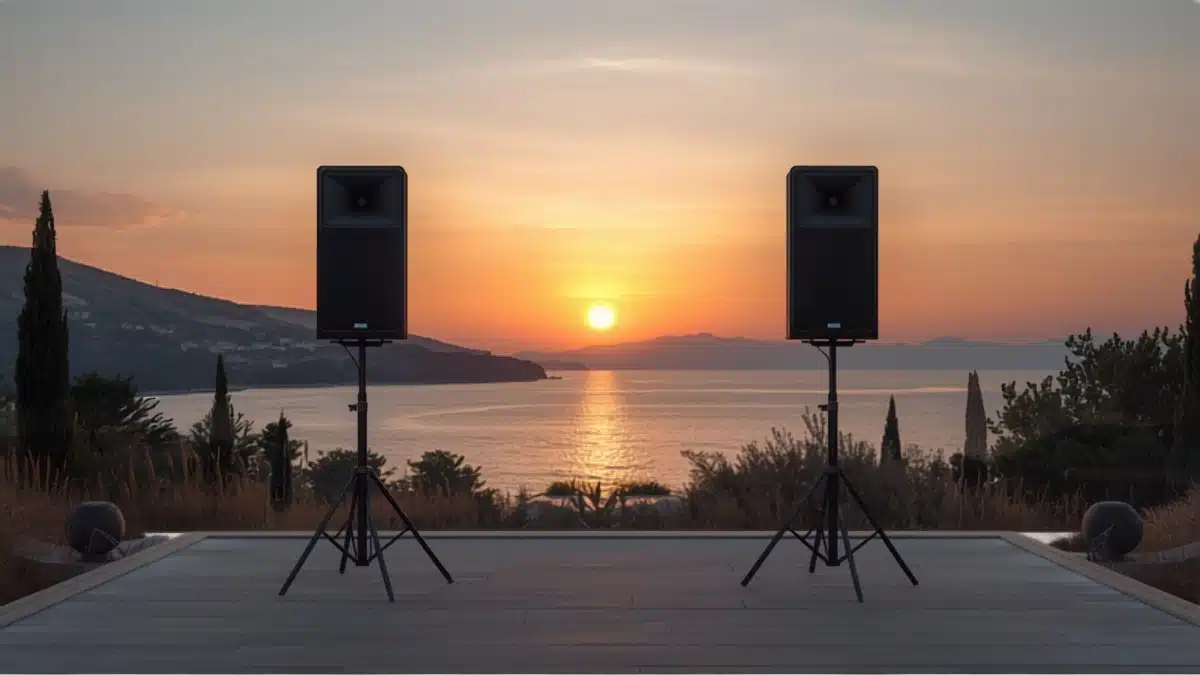
Wedding sound coverage at an outdoor venue calls for a very different setup from an indoor hall: more speakers, placed correctly, a separate system for the ceremony, a guaranteed power supply and a plan for wind and humidity. The reason is simple — outdoors there are no walls to reflect the sound, so anything that does not reach your guests directly is simply lost.
In practice, this means a system that comfortably covers 150 people in a hall can sound thin to the very same people in a garden or on a seaside terrace. It is not a question of power; it is a question of distribution. Below we explain what changes technically, what usually goes wrong at weddings in Thessaloniki and Halkidiki, and what is worth asking your venue before you sign.
What wedding sound coverage means at an outdoor venue
Indoors, sound bounces off the walls and ceiling and comes back. That is what gives the impression that the music fills the room even with just a few speakers. Outdoors, none of that happens: the sound escapes upwards and fades quickly with distance.
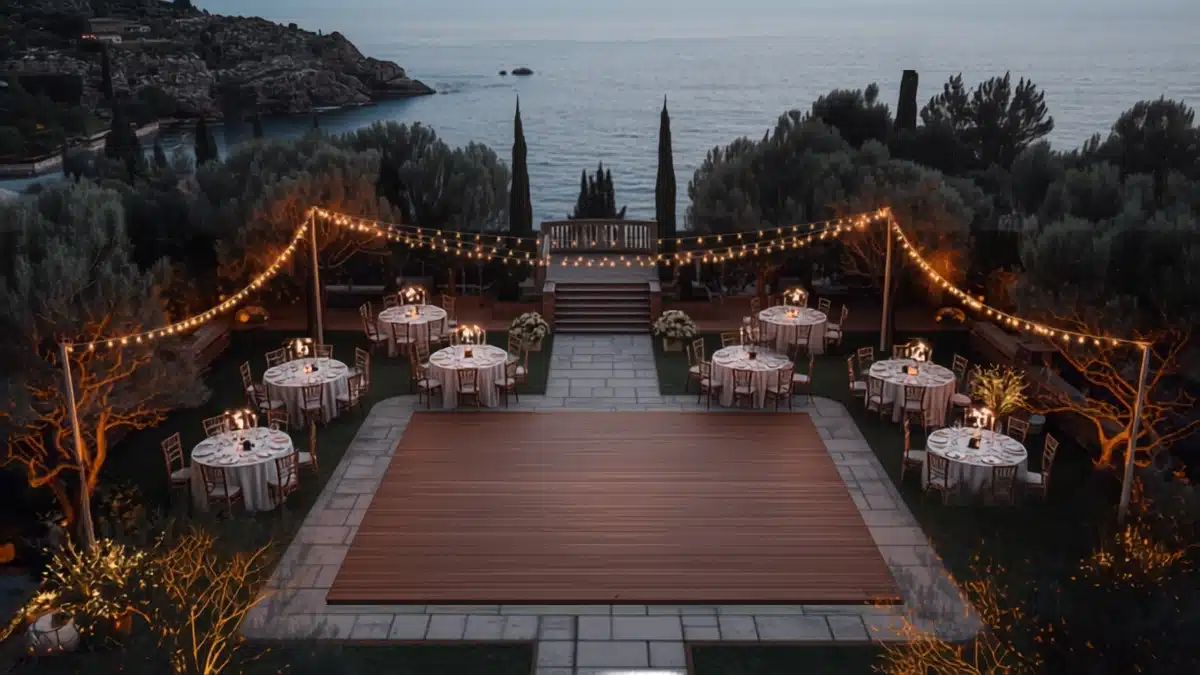
The answer is not to turn up the volume. If we do, the guests seated near the speakers cannot hold a conversation, while those further away still cannot hear properly. The answer is more sources of sound, each at a lower level — one system for the table area, one for the dance floor, and a small one for the cocktail area if it is on a different level.
This means we need to know the layout of the venue before the wedding day. A site visit or, at the very least, a floor plan showing the tables and the dance floor completely changes how we design the setup.
Wind: the factor everyone underestimates
At seaside venues in Halkidiki, wind is not a rare possibility — it is the norm. And it affects sound far more than most people imagine.
When the breeze blows from the sea towards the land, the sound is pushed in one direction: guests downwind hear it loud, while everyone else hears it as if the music had been turned down. If we position the speakers without taking this into account, the result is uneven and no amount of adjusting the volume will fix it.
Wind also creates two practical problems. The first is tall speaker stands, which become hazardous in gusts — which is why we weigh down the bases or lower the height when necessary. The second is noise in the microphones during the ceremony: without foam windshields, the wind can be louder than the priest or the registrar.
Sea humidity is a separate matter. It does not spoil the sound, but it does take its toll on the equipment, so we always make provision for covering the system when it stays set up for hours.
Power, cabling and the weather
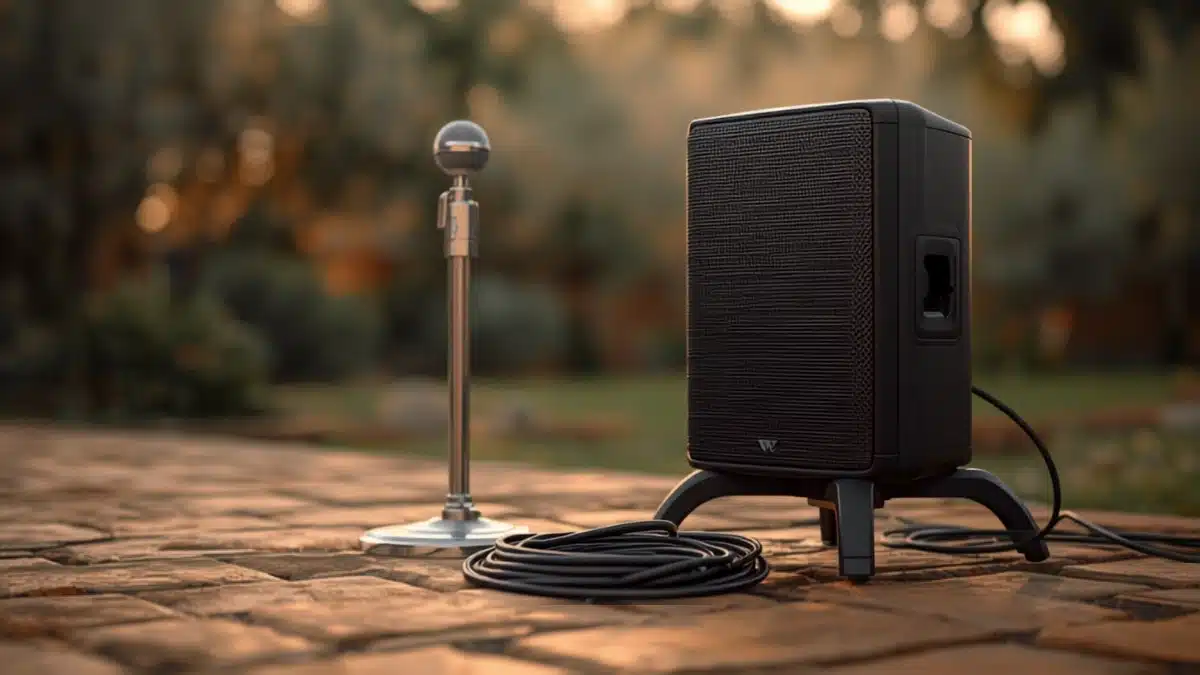
The most common technical problem at an outdoor wedding is not the sound. It is the power.
Many gardens and terraces have a single socket, often shared with the venue lighting or the caterer's refrigerators. When everything is running at once, the breaker trips — usually at the most critical moment. That is why we always ask for a separate, dedicated circuit for the sound system, and at venues without adequate infrastructure we recommend a generator.
Outdoor cabling needs care for two reasons: guest safety and protection from moisture. Cables that cross walkways are covered or routed another way. This is not a cosmetic detail — a guest tripping over a cable is a very real possibility on an evening with 200 people.
And then there is the weather: in a semi-covered or fully open venue, we need an alternative, sheltered position for the equipment in case of rain. This is agreed with the venue manager well in advance, not on the afternoon of the wedding.
The garden ceremony: the hardest part
Paradoxically, the most demanding part of an outdoor reception is not the dance floor with 300 people on it. It is the ceremony, where a single human voice has to be heard clearly at low volume, by guests seated on chairs, with no music to mask the sounds of the surroundings.
This calls for a separate, small system close to the ceremony spot and a microphone on the priest or registrar — not on a stand two metres away. A discreet lapel microphone or a microphone on a low stand gives a far better result than a large microphone that nobody wants to lean into.
If there are vows or readings by guests, a second wireless microphone is needed as well. It is two minutes of the ceremony, but it is the two minutes everyone watches again on the video.
What to ask the venue before you book
Five questions that solve most problems in advance:
- Is there a dedicated power supply for the sound system? How many amps, and where is it in relation to the dance floor.
- Is there a volume limit or a cut-off time? Many venues have one, especially in residential areas. Better to know now.
- What happens if it rains? Is there a covered alternative space, and does it hold all the guests?
- How early is access allowed for setup? An outdoor system takes more time than an indoor one.
- Where can the vehicle park for unloading? If the unloading point is far away, the setup time changes.
The answers determine what equipment we bring and how many hours in advance we start. It is the difference between a calm, well-planned setup and a rushed last-minute fix.
Frequently asked questions
Do I need more speakers because the wedding is outdoors?
Usually yes, but not more powerful ones — more points of sound. The goal is even coverage, not volume. The exact number depends on the layout of the venue and the number of guests.
What if it is very windy on the wedding day?
We adjust the position and height of the speakers and use windshields on the microphones. In extreme conditions — very strong winds or a storm — the safety of the equipment and your guests comes first, and we move to the covered alternative position.
Can the ceremony use the same sound system as the reception?
Only if the ceremony takes place in the same spot. If it is held elsewhere on the estate, a separate system is needed — there is no time to move equipment between the two, and it is not something that should be done in front of your guests.
Is a generator necessary?
Not always. It is needed when the venue does not have an adequate or dedicated supply. We find out with a simple question to the venue manager, and we would much rather know months ahead than on the day itself.
Tell us about your venue
Every outdoor venue has its own particularities — orientation, levels, power supply, neighbours. We discuss the layout with you and tell you exactly what is needed, without adding equipment that brings you no benefit.
See in detail what our wedding sound coverage includes and how we work at weddings in Halkidiki.
Request a quote through our contact page and we will come back to you with a specific proposal for your venue.