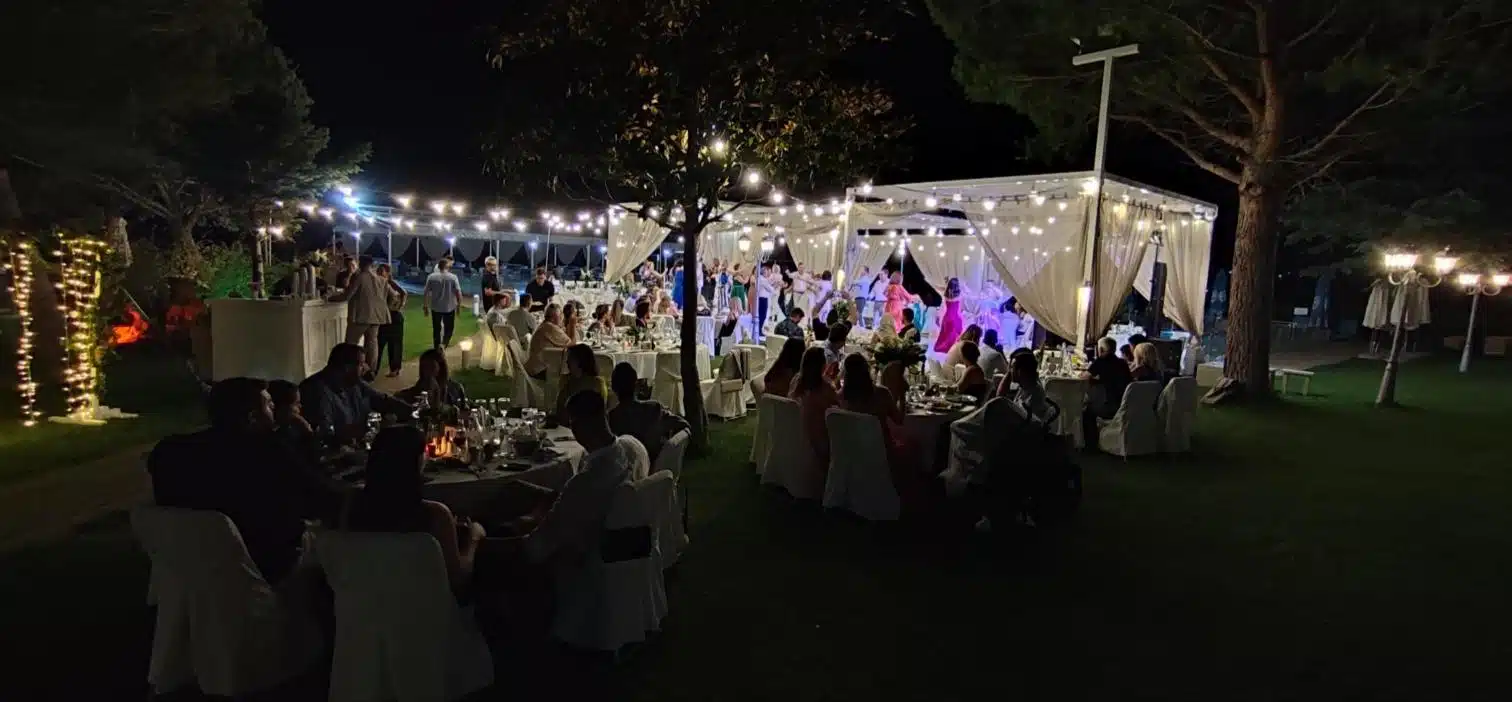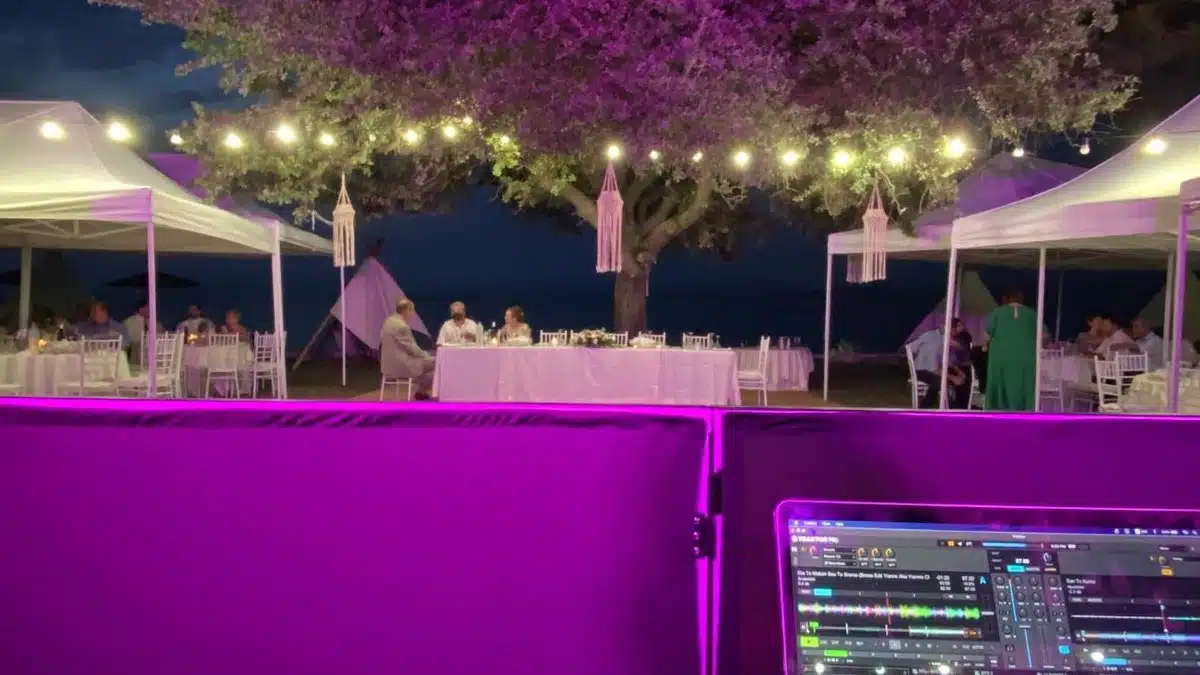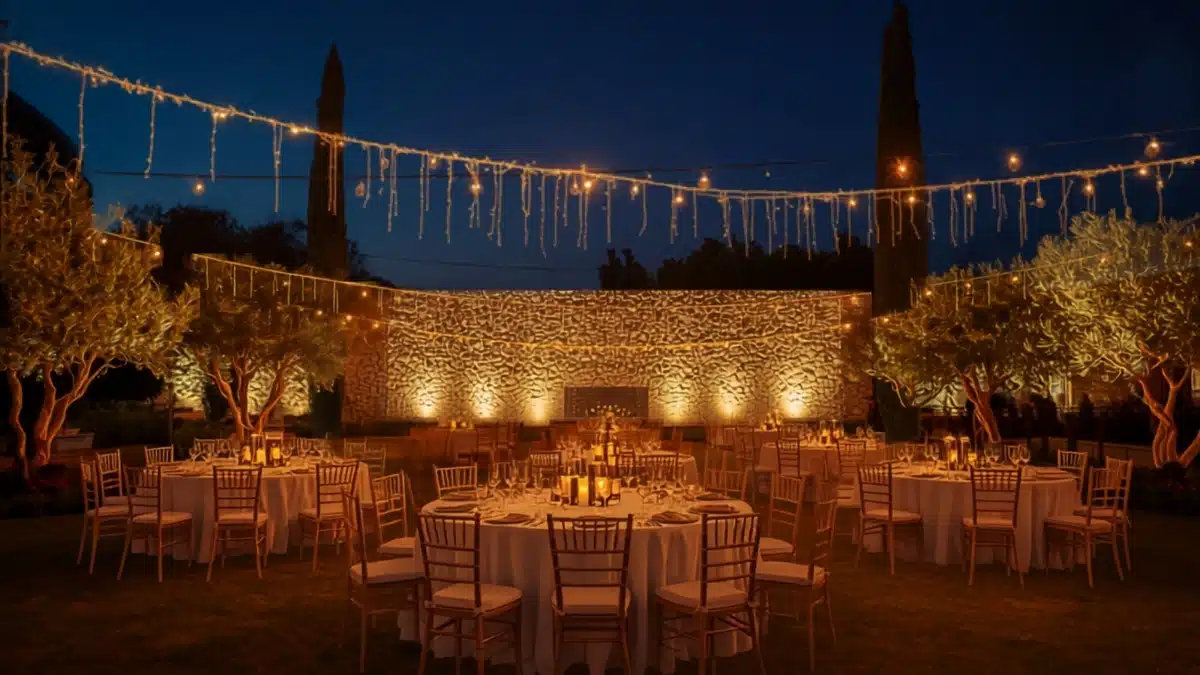
A good wedding reception timeline is a schedule that sets out what happens, when, and who is responsible for it: guest arrival and cocktail hour, the couple's entrance, dinner, first dance, opening the dance floor, the peak of the party, the closing. It is not bureaucracy — it is the only way for the venue, the photographer, the caterers and us to know at the same moment what comes next, without anyone having to ask the bride in the middle of the evening.
In practice, a reception lasts six to eight hours and has four moments that cannot be improvised: the entrance, the cake, the first dance and the opening of the dance floor. If these four are locked to a time and agreed with everyone, the rest falls into place on its own over the course of the evening. Below we describe the flow as we run it at receptions in Thessaloniki and Halkidiki, with the timings we see working in real life.
Why the wedding reception timeline is not a detail
The usual scenario without a timeline: the guests arrive before the couple, the cocktail hour drags on an hour longer because the photo session ran late, dinner is served late, the cake comes out after one in the morning, and the dance floor opens when half the guests have already left. Nobody made a mistake. It simply had never been agreed who gives the cue for the next step.
The timeline solves exactly that. It does not need to be minute by minute — it is enough that it sets milestone times and a person responsible for each transition. A single sheet of paper with six lines, shared with all your suppliers a week in advance, does more work than ten phone calls on the wedding day.
A practical note: the timeline is written once the ceremony time and the distance between ceremony and reception are fixed. Everything else is calculated backwards from there.
Arrival and cocktail hour: the first hour
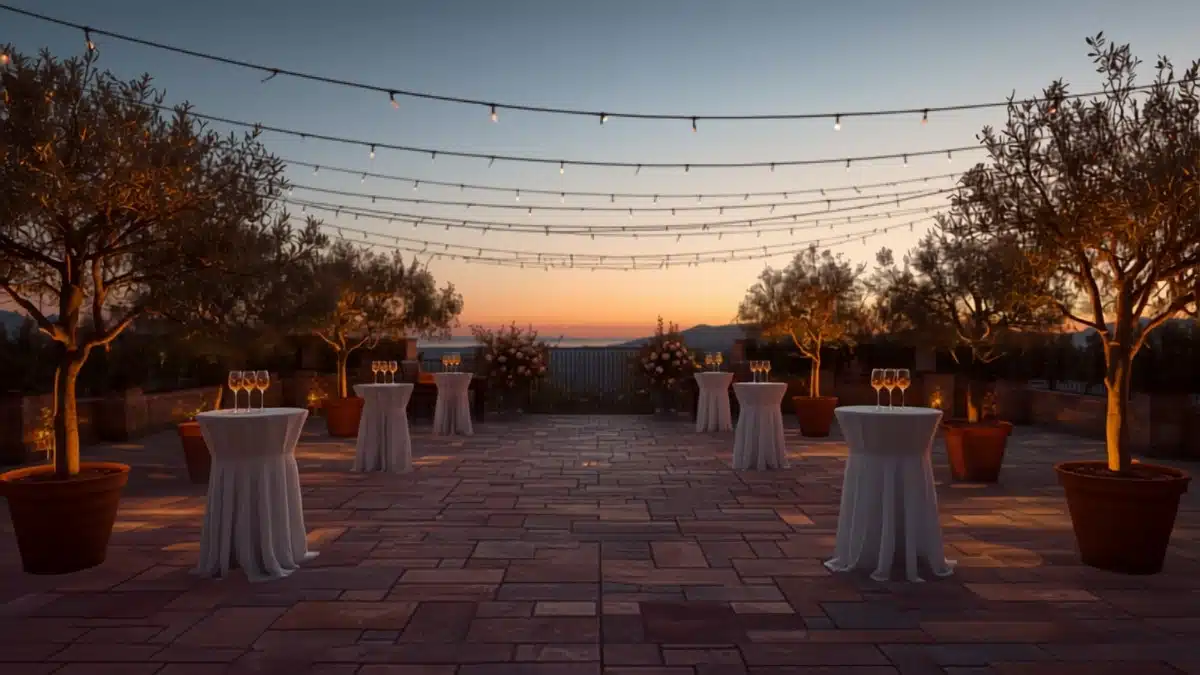
The first guests usually arrive 20–30 minutes after the time printed on the invitation. This hour is the most underrated of the evening: people are standing, drinking, looking for familiar faces and forming their first impression of the venue.
Musically, this is where we want low volume and a neutral repertoire — enough that the space does not feel empty, low enough that two people can talk without raising their voices. In practice this means not all the speakers are playing: we keep only those covering the cocktail zone active and leave the dance floor silent. It is a detail nobody notices when it is done right and everybody notices when it is not.
If the cocktail hour is outdoors and dinner is indoors, two separate sets of speakers are needed. This is not a luxury — it is the only way to avoid moving equipment in front of your guests.
The couple's entrance and dinner
The entrance is the first big moment of the evening and needs two minutes of preparation: where the couple waits before coming in, who gives them the cue, which way they walk, where they end up. The photographer and videographer need to know this beforehand, not discover it when the song starts.
After the entrance, dinner begins. Here our job is not to be heard: background music at a level that allows conversation at the table. The most common reason guests leave a reception early is not tiredness — it is that they could not talk to the person next to them for three hours.
The service sets the pace. We coordinate with the catering manager so we know when the main course goes out and when the plates are cleared, because that is what determines when we can move to the cake without interrupting anyone mid-meal.
The first dance: the most critical moment of the evening
The first dance is the bridge between the seated and the standing part of the evening. If it goes well, the dance floor opens by itself. If it goes badly, it takes thirty minutes to gather people again.
Three things we always settle in advance: the length of the track (many songs run four and a half minutes — that is a long time for two people alone on the floor, and we often do a discreet fade), the point at which the couple invites everyone else to join them, and what plays immediately afterwards. The track that follows the first dance matters more than the first dance itself: it decides whether people stay on the floor or go back to their tables.
In terms of lighting, the first dance needs the opposite of what most people imagine: less light, not more. We dim the general lighting of the room and keep warm light on the couple — both for the atmosphere and because the photographer works far better that way.
The dance floor: how the peak is built
After the first dance the evening follows its own logic and cannot be written down on paper. What is written down is the framework: roughly when the Greek music comes in, whether there is a live instrument and at which point it joins, whether something special is planned — sparkler fountains, balloons, haze.
The mistake we see most often is peaking too early. If the dance floor hits its maximum at one o'clock, by two there is nowhere left to go. We build gradually, with dips in between that give people time to drink some water and come back.
The closing also needs a decision in advance: does the venue have a finishing time? Is there a volume limit after a certain hour? Many estates around Thessaloniki have one, and it is far better to know in March than at three in the morning.
The three things that usually break the flow
The ceremony running late. It almost always does, and almost always by 20–40 minutes. The timeline has to allow for it, not ignore it. The buffer goes into the cocktail hour, which is the only part that can stretch without hurting anyone.
Speeches without a microphone. If a speech or toast is planned, you need a wireless microphone and someone to hold it. Without that, half the guests hear nothing and the moment is lost.
Moving between spaces. Ceremony in the garden, dinner in the hall, dancing on the terrace: every move takes time and usually a separate sound setup. If it has not been planned for, that is where the timeline breaks.
Frequently asked questions
How early should the reception timeline be ready?
A draft two months before and the final version two weeks before is a comfortable pace. The final version should reach all your suppliers at least one week in advance.
Who coordinates the evening if there is no wedding planner?
Usually the DJ, in coordination with the venue manager. The DJ is the only person who has a microphone and can see the dance floor and the tables at the same time. That is why we discuss the flow with you in advance rather than leaving it to chance.
Can the timeline change during the evening?
Yes, and it often does. The timeline is not a binding contract — it is a shared point of reference. When everyone knows the original plan, a change of course happens with a nod instead of five phone calls.
How long should dinner last?
It depends on the menu and the number of guests, but after two and a half hours seated, people start to lose their energy. If the menu is long, it is worth placing something in between — the cake or a short musical moment.
Let's build the flow of your evening together
Every venue and every couple has different needs. We go through the flow in detail before the wedding and share it with all your suppliers, so that you do not have to deal with any of this on your wedding day.
See what our wedding music services include and how we work as a wedding DJ in Thessaloniki. For the technical side, read about wedding sound coverage.
Request a quote and we will send you a draft timeline for your own venue.